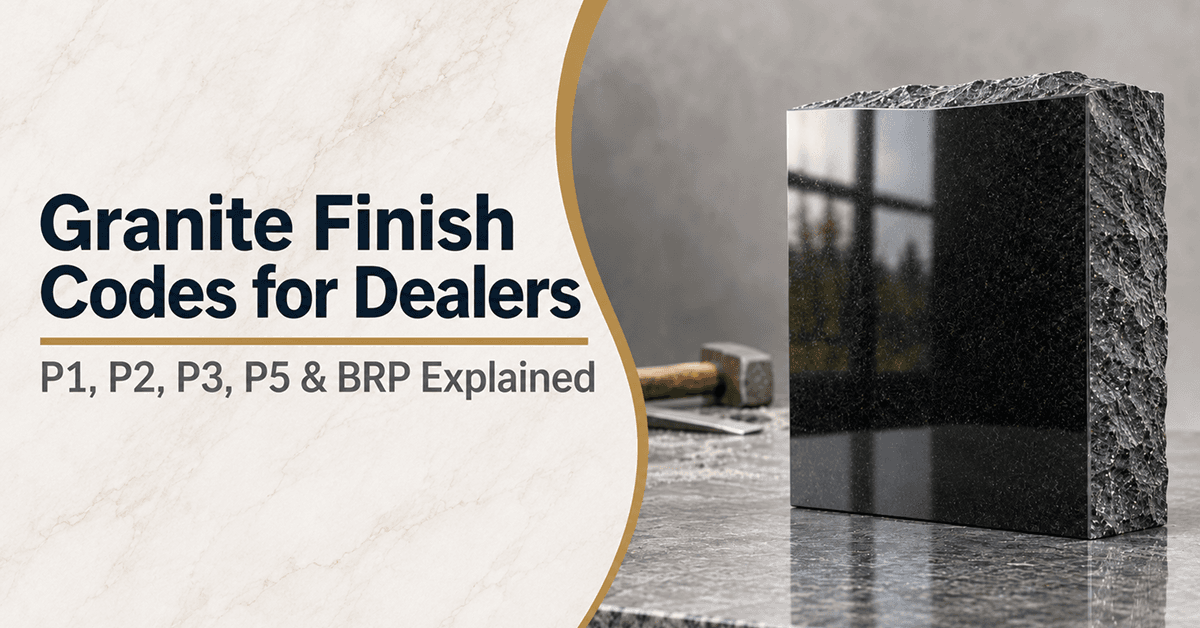
In granite monument codes, the "P" number counts how many exposed faces are polished: P2 is front and back, P3 adds the top, and P5 is all five exposed faces. BRP means "balance rock pitched": every remaining face is left with a hand-split natural texture. So "P2 BRP" means front and back polished, with the top and both ends rock pitched. Factory codes can differ slightly from one supplier to another, so the definitions below are Stone Discover's. Always confirm them in writing before you place an order.
Key Takeaways
- P1, P2, P3, P4 and P5 count polished faces. BRP, SS and BS describe what happens to the other faces.
- P2 BRP is the most common code for upright dies. PFT SS and PFT BRP are common for flat markers and bases.
- The bottom face is never counted. P5 means all five exposed faces.
- Each extra polished face adds work and cost. Rock pitching and sawing are the lower-cost ways to finish hidden or secondary faces.
- Cemetery rules can restrict finishes, especially on flush markers and in heritage sections.
- A good order line states size, granite color, finish code and engraving requirement in one place. This avoids most disputes.
What Do Granite Finish Codes Mean? Finish Codes at a Glance
Finish codes are the shorthand monument dealers and factories use to describe which faces of a stone are polished and what happens to the rest. They reduce a long finishing description to a few letters.
Face key: F is front, B is back, T is top, E is the two ends. The bottom face sits on the base or foundation and is not counted.
| Code | Meaning | Polished Faces | Remaining Faces | Typical Use |
|---|---|---|---|---|
| P1 | Polished one face | F | Sawn or rock pitched | Face-only visible pieces |
| P2 BRP | Polished two faces, balance rock pitched | F, B | T, E rock pitched | Upright dies |
| P3 BRP | Polished three faces, balance rock pitched | F, B, T | E rock pitched | Dies with a polished top that sheds water |
| P4 | Polished four faces | F, B, E | T unpolished | Bench legs and similar |
| P5 or AP | Polished five faces, or all polished | F, B, T, E, E | None | Vases, benches, premium dies |
| PFT BRP | Polished flat top, balance rock pitched | Top face | Sides rock pitched | Bases |
| PFT SS | Polished flat top, sawn sides | Top face | Sides sawn | Flat and grass markers |
| BRP | Balance rock pitched | None specified | All other faces rock pitched | Sides, backs, bases |
| BS or SS | Balance sawn or sawn sides | None specified | Flat saw-cut faces | Hidden or secondary faces |
Image brief for your design team: A labelled 3D die with the five exposed faces color-coded, and the P2 BRP, P3 BRP and P5 versions shown side by side. Alt text: "Granite die showing P2 BRP, P3 BRP and P5 finish codes."
A note on variation: some factories write "P2" and assume BRP on the rest without saying so, and others treat sawn as the default. That is why we always write the full code, such as "P2 BRP", on drawings and quotes.
What Is the Difference Between Polished, Rock Pitch, Honed, Flamed and Sawn Granite?
Each finish is a different surface treatment, and each changes how the stone looks, reads and ages.
- Polished. A mirror-gloss surface that brings out the stone's deepest color. On black granite, polish gives the darkest value and the strongest contrast for lettering. In direct sun it can create glare. Polished faces are what P codes count. See our granite varieties to compare how colors read once polished.
- Rock pitch. A natural, rough fracture made by splitting the stone by hand with a hammer and chisel. Dark granite looks lighter and greyer on a rock-pitched face. It is the standard choice for sides, backs and bases, and BRP uses it for every face not otherwise specified.
- Honed. Partly polished, so the surface is very smooth but not shiny. It is used sparingly, mostly to create a contrast panel next to polished areas or where glare is a concern.
- Steeled, dusted or Tiffany. A frosted, velvet-like surface created by sandblasting away the polish. It is the usual contrast panel behind sandblasted lettering, and it also reduces glare. Different suppliers use different names for it, so describe it on the order.
- Flamed. A heat-treated, rough, textured surface. It lightens the stone's apparent color and is more common for paving and steps than for headstones. Offer it only where a customer asks for a textured top.
- Sawn. The flat, slightly lined surface left by the saw. It is the lowest-cost way to finish hidden or secondary faces, and it gives the tightest fit where stones join.
- Image brief: Close-up photos of the same black granite in polished, rock-pitched, honed and sawn finishes. Alt text: "Black granite finishes compared: polished, rock pitch, honed and sawn."
Does Finish Affect Granite Monument Price?
Yes. Finish changes cost because every polished face adds machine time and labor, and hand-splitting adds labor of its own. The general pattern holds across most suppliers.
| Finish Approach | Relative Cost | Why |
|---|---|---|
| Sawn on all faces except the front | Lowest | Least processing |
| P2 BRP | Low to moderate | Two polished faces plus hand-split edges |
| PFT SS or PFT BRP | Low to moderate | One polished face plus sawn or split sides |
| P3 BRP | Moderate | Three polished faces |
| P5 or all polished | Higher | Every exposed face polished |
| Added contrast panels (steeled or honed) | Adds a line item | Extra surface work |
Two practical points follow for dealers. First, upgrading from P2 to P3 or P5 changes the cost and the retail positioning, so state the finish on every quote. Second, you can protect your margin on standard stock by fixing a house finish, such as P2 BRP for dies and PFT BRP for bases, and quoting upgrades separately. Our wholesale headstone prices Canada guide shows how size and volume affect price. Finish sits on top of that.
How Do You Write Finish Codes on a Purchase Order?
Write the order line in the same sequence every time: product, size, granite, finish code, engraving. A consistent line means the factory, your engraver and your customer all read the same thing.
| Item | Sample Line |
|---|---|
| Upright die | Single upright die, 24 x 6 x 24 in, Absolute Black, P2 BRP, blank for sandblast, qty 20 |
| Matching base | Base, 30 x 10 x 6 in, Absolute Black, PFT BRP, qty 20 |
| Flat marker | Flat marker, 24 x 12 x 4 in, Absolute Black, PFT SS, polished blank, qty 40 |
| Bevel marker | Bevel marker, 24 x 12 x 6 in, Steel Grey, PFT BRP, qty 15 |
| Vase | Vase, 6 x 6 x 10 in, Absolute Black, P5, qty 30 |
Dimensions follow the order width x depth x height. If you need the standard size ranges first, use our headstone sizes guide for North America.
Four rules that prevent disputes
- Always write the full code, for example "P2 BRP", never just "P2".
- State whether the piece is a blank for local engraving or factory engraved.
- Name the granite color on the same line, because the finish looks different by color.
- Attach the cemetery section rules if they limit finish or size.
Browse the flat headstones, bevel marker, upright headstone and headstone vase pages to see standard finishes for each product.
Which Finishes Work for Granite Columbaria and Community Memorials?
Columbaria and community memorials have more visible faces than a headstone, so the finish plan matters more. Common specifications include polished niche faceplates for engraving clarity, polished or honed exteriors where all sides are seen, and rock-pitched or sawn base courses. Roof edges are often rock pitched for contrast.
Where the whole unit is seen from several sides, specify P5 or all polished on the visible components. Where glare is a concern in bright, open gardens, a honed or steeled panel behind the lettering helps readability. Hidden joint faces are finished sawn so the sections fit tightly, and we number each component to match the assembly guide.
For project detail, read our guide to granite columbarium supply for Ontario and Canada and browse the columbarium range. Matching memorial benches in the same finish complete a cremation garden.
What Finish Requirements Do Cemeteries Set?
Cemeteries set finish rules the same way they set size rules: by section. Check the following in writing before you order.
- Whether polished faces are allowed, or whether a matte or natural finish is required in that section
- Whether rock pitch is permitted on flush markers, since rough edges can interfere with mowing
- Required edge treatment and thickness for flat markers
- Finish rules for heritage, churchyard and natural burial sections
- Whether the base must match the die in color and finish
- Any restrictions on polished black granite in conservation areas
Rules differ by province, state, municipality and section, so keep the written approval on file. Our Canada supply hub outlines the provincial differences we see most often.
How Does Finish Affect Winter Performance?
Finish matters most in climates with freeze-thaw cycles and de-icing salt. A polished face is dense and smooth, so it sheds water and does not trap salt. Rough or textured faces have more surface area, so they hold more moisture and are more likely to show wear along natural fracture lines over many winters.
That is why material quality comes first. Low-porosity granite is the foundation of winter performance, and finish is the second layer. Read our quality assurance guide for how we check finish consistency before every shipment.
Get the Finish Chart and a Factory-Direct Quote
Stone Discover has manufactured and exported granite memorials since 1984, with ISO 9001 certified manufacturing. We supply monument dealers, funeral homes and cemetery suppliers across the USA and Canada, from 10 pieces per design.
Download the catalog chart (PDF)
Request a trade quote
Frequently Asked Questions
What does P2 mean on a headstone?
P2 means two faces are polished: the front and the back. The remaining faces are usually rock pitched, which is why the code is often written "P2 BRP".
What does P2 BRP granite mean?
P2 BRP means the front and back are polished and the top and both ends are balanced rock pitched. It is the most common finish code for upright dies.
What does BRP mean in granite?
BRP stands for balanced rock pitches. Every face not otherwise specified is left with a hand-split natural texture.
What is the difference between P3 and P5?
P3 polishes the front, back and top, leaving the ends rock pitched. P5 polishes all five exposed faces: front, back, top and both ends.
Do finish codes differ between factories?
Sometimes. Some factories assume BRP or sawn faces without writing them. Always request the full code and a written definition, and confirm it on the drawing.
Does polish level affect granite monument price?
Yes. More polished faces mean more processing, so P5 typically costs more than P3, and P3 more than P2. Ask for finish upgrades as separate line items.
What is the difference between polished, honed and flamed granite?
Polished is high gloss. Honed is smooth and matte. Flamed is heat-textured and rough. Polished and honed are used on memorials. Flaming is rarely used on headstones.
What finish should a flat marker have?
Flat markers are commonly specified PFT SS: a polished flat top with sawn sides. Always check the cemetery's rules on edges and thickness.
What finish suits a granite columbarium?
Polished niche faceplates with polished or honed exteriors are common. Rock-pitched or sawn base courses and roof edges give contrast.
How do I order granite monuments with finish codes?
Write product, size, granite colour, full finish code and engraving requirement on each line, and attach any cemetery rules.